Digital Ppal-let-ter Project

Digital Ppal-let-ter Project

Jung Moon

PhD Candidate

Centre For Ideas, University of Melbourne

Why?

Through various and deeper ways of study such as an academic research (e.g. literature research) and qualitative/quantitative research (survey and deep focus group interview), I could realise and identify who ajummas are and their behaviour of mobile communication through using smartphones in their daily lives. Digital Ppal-let-ter project is a part of Smart Ajumma research project that expresses my research findings and interpretations metaphorically through a video humorously but the stories are still based on academic research in order to avoid losing the purpose of this research project.

Ppal-let-ter (wash place)?

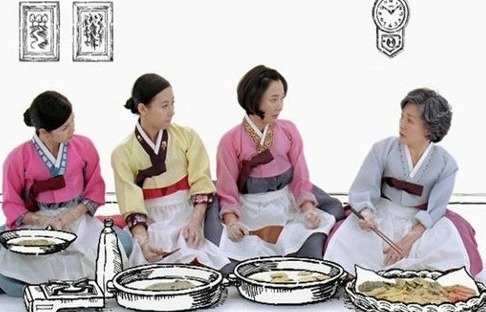
I was amazed through enjoying this research project for last few years. Ajummas in Korea, they actually have their own communal spaces and keep doing communication with each other by their own ways. We didn’t know about their communal spaces and their ways of communication because we just stared at them rather than looking inside deeply.

After I found that there are communal spaces for ajummas’ own through doing field research, I could keep continuing this creative research project. And I thought about Ppal-let-ter (wash place)!

Of course, there are many countries had wash places but a wash place in Korea can be considered as a characteristic place than other countries’. As I mentioned so many times, a wash place in Korea is more likely a women’s communal space before 1960s. There are sill wash places in Korea but those places haven’t been used as a wash place for a long time. They rather became tourist spots today because we have washing machines at home to do our laundry instead of going to wash places regularly.

Whereas, going to the wash place regularly was a matter of course for village women (or ajummas) not only doing their laundry, but also meeting other village women (or ajummas). In other words, the wash place was a place for ‘socialising’ and ‘communicating’ for middle-aged and married women in Korea during 1960s.

They don’t have an appointment with each other, but they could meet someone whenever they visit the wash place. So it was possible to have conversations with each other about various topics from complaining patrilocality to boasting their children. The wash place functioned as more than ‘wash place’, rather it played a role as a women’s communal space. Thus, I got inspired by this important but being forgotten wash place to start doing my creative project so called as ‘Digital Ppal-let-ter’.

Women’s place?

Even though there are various types of women’s communal spaces such as hair shops and jjim-jil bang (sauna), the reason why I chose a wash place as a key space to do my creative project is because I thought a wash place is one of women’s communal spaces and it has sentiments of Koreans and Korean culture.

In the late 18th century, ‘the wash place’ by Hong Do Kim shows how a wash place in Korea could be a women’s place even though there were no law and regulations that prohibited men from coming to a wash place.

Digital Ppal-let-ter?

Through survey and focus group research, Kakao Talk’s group chat room was the most preferred way of mobile communication among ajummas. Some of interviewees responded that they purchased smartphones only for using Kakao Talk’s with their friends and family. Like this, Kakao Talk’s group chat rooms were now newly used as communal spaces or the ways of communication today.

Of course, Kakao Talk is one of mobile chatting applications that anyone can use freely. However, I discovered that Kakao Talk’s group chat room in 2016 and the wash place in the before 1960s have much analogy with each other in many ways. (I already wrote about the 6 similarities between wash place and Kakao Talk’s group chat room in my blog)

These two dissimilar places that came from totally different time are very much similar with each other. This makes me so exciting.

Digital Ppal-let-ter = A communal place for Ajummas?

These two places are dissimilar, it is so true. However I realised that they are very much similar with each other at the same time. We’re now using smartphones and the use of smartphones allow us to do many things that we never imagined in pre-smartphone era.

I think ajummas in Kakao Talk’s group chat room and their communication in mobile space are not an entirely new things that could be possible due to the development of new technologies. Maybe, they’ve been communicating with each other in their own communal spaces by their own ways of communication.

In other words, the wash place in the before 1960s was not disappeared at all, rather I consider the wash place continues to exist with us in the shape of Kakao Talk’s group chat room.

We’re now using different communicative tools and methods. And we’re communicate in dissimilar communal spaces compared with pre-smartphone era. Even though many things had been changed, we shouldn’t forget one thing that middle-aged and married women in Korea have been communicating continuously regardless communicative tools, methods, time and spaces.

Digital ppal-let-ter in the future?

Digital Ppal-let-ter is not a new thing at all. It is a women’s communal place today.

The communicative method (from face-to-face to mobile communication), communicative tools (from direct dialogue to smartphones) and communal spaces (Ppal-let-ter (wash place) to Digital Ppal-let-ter (Kakao Talk’s group chat room) are changed, I expect that communication among ajummas will be evaluating continuously with their own ways.

Thus, a discovery of Digital Ppal-let-ter is very important and it must continue to research how this Digital Ppal-let-ter will developing or changing in the future. We shouldn’t be overlooked ajummas in new media and communication research. They’re one of unique female group in Korea and we’re ready-to-be ajummas in the future as well.

Holiday Syndrome?

Time flies and it’s already February in 2016! Of course we had new year holidays at the beginning of this year, January. However, we (Koreans) have another new year on this coming Monday (8th Feb 2016). From yesterday we’re having a new year holiday until mid of next week. Most people (non-Koreans) think this late new year is called ‘Chinese New Year’. It is so true but we say Korean new year or just Lunar new year. I love holiday (who doesn’t?) especially Korean holidays because I can meet my cousins, aunties, uncles etc. Sadly, my grandma had passed away two years ago so I can’t see her lovely smile any more but still I love to meet my relatives.

Whenever I say I love Korean holidays to my friends especially married ones, all of them told me, “if you are married, you couldn’t love Korean holidays any more, for sure!”. I know what they mean because this is very controversial topic for every Korean woman (especially married women). It is ‘Holiday Syndrome’!

File 6-02-2016, 4 55 21 PM.jpeg

Ajummas in the supermarket to do grocery shopping for Korean New Year 2016

Traditionally, we have a memorial service for ancestors (e.g. great-great-grandparents, great-grandparents, grandparents) on every Korean holiday such as Korean new year, Chuseok (Korean Thanksgiving day) etc. On these holidays, we have to prepare food for ancestral rites table and at the same time for ourselves (family members). This is very good Korean tradition to admire our ancestors on every Korean holiday and relatives could be able to reunite together regularly through enjoying these Korean holidays. However, there is a big problem.

As I mentioned before in my blog post about Women in Korea (2) Before IMF on 11th Jan 2016, Korean society was severe patriarchal society from 1980s to 1990s. Women (mothers, wives, ajummas) had to sacrifice their lives to support husbands and children. This happened in the past and now the society has been changed a lot. Women are also working outside and they push themselves hardly to build their careers. They’re not staying at home to support their family by sacrificing their lives any more. I don’t mean that sacrificing their lives to support husbands and children like our mothers in the past were worthless. I mean the women in today have more opportunities to build their careers than 1980s so they can’t just be a stay-at-home mother rather they should work outside for their careers.

However, the problem is that the social structure and people’s mind haven’t changed a lot. It is like we can do real-time free video chatting through our smartphones  but people still use only voice calling with their high-tech smartphones. Society forces women to build their careers and get higher education but this society doesn’t allow women to be free from their family affairs that the society thinks ‘women’s full time job’. This can be a jump of logic but I think Korea is still very much patriarchal society even though there are so many opportunities for women, especially married women to work outside to build their careers compared with before in 1980s.

Holiday syndrome was also came from this patriarchal social structure, I think. All the daughters-in-law must go to their mothers-in-law’ houses to prepare food for their ancestors on every Korean holiday. And the problem is that many of husbands (or sons of mother-in-law, father-in-law or any ‘male’ human beings) don’t support, help or assist their wives at all. They think preparation of food for their ancestors are entirely ‘women’s duty’ for a very long time so these husbands never try to help their wives. Also mother-in-law don’t want their sons to work in the kitchen. This is also related to the Korean concept of predominance of man over woman. For this reason, there was a saying that ‘male must not come in the kitchen’. 

1.jpg

daughters in law with a mother in law prepare food
image from <http://blog.daum.net/youngho7995/99>

I understand how Korean society had the feudalistic convention of regarding men as superior to women in the past. But the past is past and now is now. We have to change our wrong feudalistic thinking about men and women. Korean holidays are more than worth to enjoy because we can learn our histories, traditions and even ‘Jeong’ with our family and relatives. We are also allowed to think about our ancestors and our roots as well. If our mothers and daughter in law can’t enjoy these holidays, preparing food for other family members can’t be women’s duty any more. It become just women’s stressful work.

110206_18_2.jpg

image from <http://news.kmib.co.kr>

The news reports about holiday syndrome of married women can be seen on TV or in the Internet every year. Our ajummas are suffering from Korean holiday syndrome for many years. The resolution is very simple. Holidays are for everyone. Please do prepare together and enjoy together.

‘Male must come in the kitchen. You’re more than welcome’

297223_8.jpg

image from Pocket Monster, <http://bbs2.ruliweb.daum.net/gaia/do/ruliweb/family/230/read?bbsId=G005&articleId=7994370&itemId=75>

Jeong

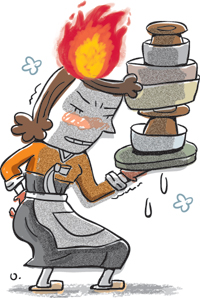
Jeong is an ambiguous and amorphous concept. There is no word that replaces the meaning of Jeong in Korean vocabulary. Also I can’t find any equivalent English word to Jeong. According to Kim ,

“Jeong encompasses the meaning of a wide range of English terms: feeling, empathy, affection, closeness, tenderness, pathos, compassion, sentiment, trust, bonding and love… Koreans considers jeong an essential elements in human life, promoting the depth and richness of personal relations… With jeong, relationships are deeper and longer lasting… Jeong is what makes us say “we” rather than “I”, “ours” than “mine” (U Kim 1994, cited in Kim 1996, p.14)”.

If someone asks me what jeong means, I probably cannot answer immediately not only in English, but also in Korean. To explain what jeong is not simply thing at least for me. I might say, to know what jeong means should be realised through experiencing Korean culture rather than learning by books or any academic theories.

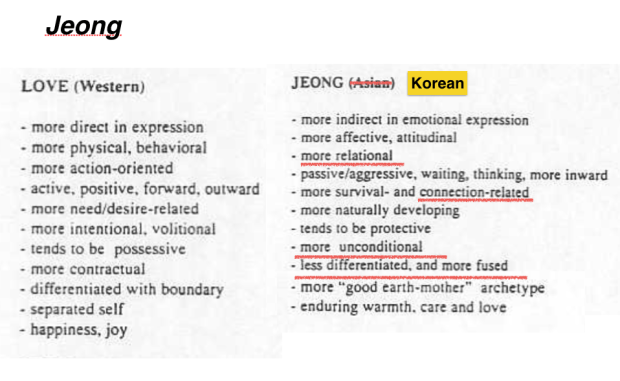
Jeong is similar to love but jeong is different from love. (see below)

Screen Shot 2016-01-19 at 6.28.40 PM.png

Figure 1. (Kim 1996, p.15)

Jeong is ‘more relational’,  ‘more connection-related’,  ‘more unconditional’ and ‘less differentiated and more fused (think about ‘Korean collectivism’ that I mentioned in previous post)’ than love according to figure 1 that I attached above.

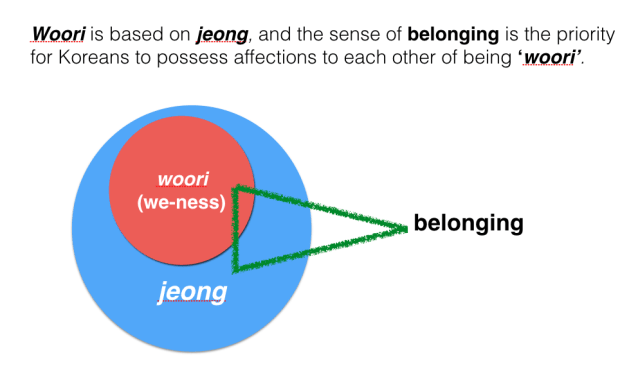
So, Koreans or ajummas could do gold collection campaign to support Korean economic during IMF because this Korean collectivism led them to feel being woori (we-ness). And being woori (we-ness) was possible because they were connected to jeong with each other.

Screen Shot 2016-01-19 at 6.41.02 PM.png

Thus, they could be ‘woori (we-ness)’ because of having jeong with each other and also they belong to the same group (Korea society).

Screen Shot 2016-01-19 at 6.47.08 PM.png

In Korea, there are various groups and sub-groups. For example, when I was a uni student, I belonged to catholic church group, high school friends group, ski group, uni friends group, English study group, home town friends group etc. Like me, many Koreans belong to various groups and sub-groups because belonging is important for us. And this belonging allows us to have relationships with others to become ‘woori (we-ness)’ and sharing ‘jeong’ with each other. (Think about examples that I’ve posted in previous post, Group Singing is also a good example of ‘woori, jeong and belonging’)

If I apply this theory to the group of ajummas, ajummas can be one of sub-groups of Korean society. They become woori (we-ness) through having jeong with each other and they belong to similar interests, age and gender group. So ajummas could be considered as a kind of sub-groups of Korean society that are intertwined with jeong. 

For next post, I will (finally) talk about Smart Ajumma!!


Korean collectivism (we-ness)

The gold collection  campaign were possible because of Korean collectivism which is We-ness, Uri (or Woori). Uri,  we-ness, or in group-ness as a more essentially relevant feature of Korean collectivism. The social relationship among Korean in-groups are based on social networks, the sophisticated genealogical system, the power of school connections, or regionalism. For Koreans, group is very important. To explain or talk about Korean collectivism in one blog post is not enough but this blog is not a ‘thesis’ rather a blog that I would like to share my research project, especially about ‘ajummas and their usage of smartphones in everyday practices’. In addition, I need to mention about Korean collectivism to support some ideas (e.g. gold collection campaign). Moreover, it might be helpful to you to understand Korea and ‘ajummas’ in Korean society if you know what Korean collectivism (we-ness) and Jeong means.

Screen Shot 2016-01-19 at 11.44.46 AM.png

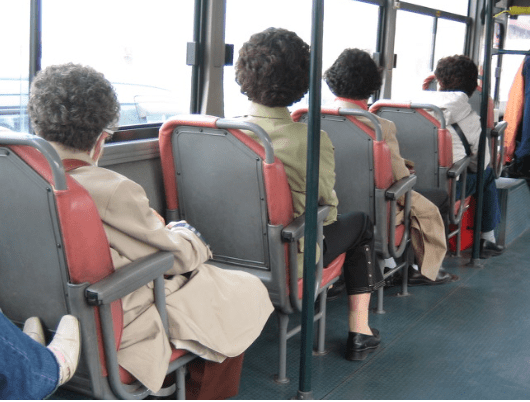
This image explains how ajummas have similar hair styles in Korea. More stories about ajummas will be posting continuously.

image from <http://kfoodtalker.tistory.com/3442>


Of course, there are negative opinions how Korean collectivism ignores everyone’s individuality and force to be standardised. For me, Korean collectivism can be pros and cons in many ways. It leads people to be united and do something together such as Red Devils (supporting group for the Korea Republic national football team), Group Singing or Gold collection campaign. This Korean collectivism brought people to feel like ‘We are Koreans’ or ‘We are  one’. And in my experience, this Korean collectivism doesn’t allow me to be different from others. In other words, being different from others is not an ideal thing to be in certain groups. Thus I have to become similar with others in groups to stay in certain groups. This is just my opinions so there should be various ideas about Korean collectivism.

Screen Shot 2016-01-19 at 11.32.50 AM.png

image from Koreatimes.co.kr <http://www.koreatimes.co.kr/www/news/biz/2014/01/291_67541.html>


Group Singing

Screen Shot 2016-01-19 at 12.34.41 PM

High school students wear the same North Face jumpers at graduation ceremony

image from: photohistory.tistory.com  <http://photohistory.tistory.com/11401>

Screen Shot 2016-01-19 at 12.34.10 PM

Ajummas wear similar mountain-climbing clothes in the subway


This Korean collectivism can be explained with the concept of ‘Woori (we-ness)’.

Woori (we-ness)

Screen Shot 2016-01-19 at 11.06.19 AM.png

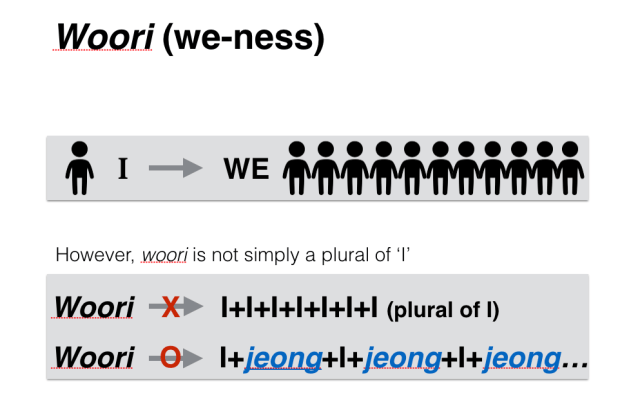
We is a plural of ‘I’ in linguistic. So a group of ‘I’ can be interpreted as ‘Woori’ (because Woori means ‘we-ness’ in English).

However, Woori is not simply a plural of ‘I’. As you can see above, woori is not a simply a plural of ‘I’, and it needs ‘jeong’ between ‘I’ to become woori.

Then, what is Jeong?