Kakao Talk vs Wash place

After survey and Focus group interview, I suddenly realised that Kakao Talk can be a women’s communal space in these days. Of course Kakao Talk is not designed for only women and many people use it every day regardless of the age and genders. However, their group chat rooms, the chat rooms for ajummas where they’ve created and they’re involved in. That can be a women’s communal place, I reckon. So I started to find a women’s communal spaces. Hair shop, Sauna, etc. But I want to find a ‘Korean’ women’s communal spaces. For this reason, I found the wash place.

Screen Shot 2016-02-19 at 12.03.16 PM


Screen Shot 2016-02-19 at 12.03.05 PM

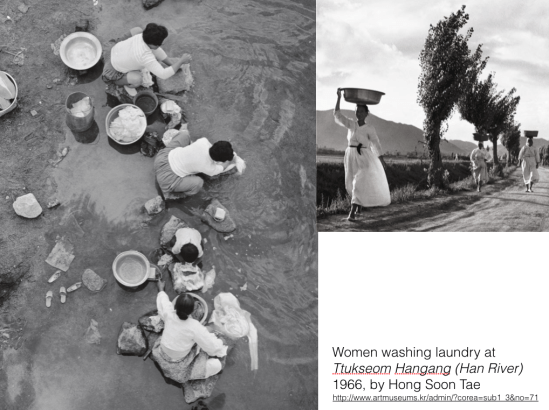
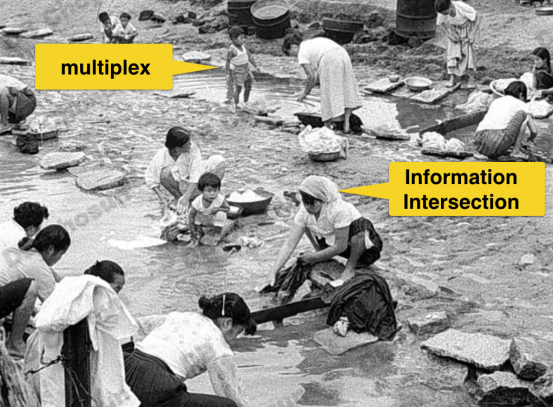
Of course, every country has or had the wash place. But, Korean wash place was a bit different from any others’. We don’t have to go to the wash place to do laundry today due to almost every house have technologically developed and upgraded washing machines. Or there are coin laundry shops nearby our houses. Whereas, back in 1960s, going to the wash place and doing the laundry is must do thing for women in Korea. And this wash place was like a multiplex where women not only do their laundry but also meeting others and even taking bathes.

Screen Shot 2016-02-19 at 12.03.27 PM

They don’t make an appointment for meetings, but they expected to meet someone whoever they go to the wash place and of course they could meet someone in that place. As a social place, women in Korea they could share useful information or sometimes just mundane gossips about their mother-in-law, etc.

Thus, wash place for women in Korea during 1960s was not a place only for doing their laundry. It is more like a communal space at that time. Wash place during 1960s in Korea was considered as a ‘women-only communal space’ even though there was no law and regulations that prohibited men to come in.

Holiday Syndrome?

Time flies and it’s already February in 2016! Of course we had new year holidays at the beginning of this year, January. However, we (Koreans) have another new year on this coming Monday (8th Feb 2016). From yesterday we’re having a new year holiday until mid of next week. Most people (non-Koreans) think this late new year is called ‘Chinese New Year’. It is so true but we say Korean new year or just Lunar new year. I love holiday (who doesn’t?) especially Korean holidays because I can meet my cousins, aunties, uncles etc. Sadly, my grandma had passed away two years ago so I can’t see her lovely smile any more but still I love to meet my relatives.

Whenever I say I love Korean holidays to my friends especially married ones, all of them told me, “if you are married, you couldn’t love Korean holidays any more, for sure!”. I know what they mean because this is very controversial topic for every Korean woman (especially married women). It is ‘Holiday Syndrome’!

File 6-02-2016, 4 55 21 PM.jpeg

Ajummas in the supermarket to do grocery shopping for Korean New Year 2016

Traditionally, we have a memorial service for ancestors (e.g. great-great-grandparents, great-grandparents, grandparents) on every Korean holiday such as Korean new year, Chuseok (Korean Thanksgiving day) etc. On these holidays, we have to prepare food for ancestral rites table and at the same time for ourselves (family members). This is very good Korean tradition to admire our ancestors on every Korean holiday and relatives could be able to reunite together regularly through enjoying these Korean holidays. However, there is a big problem.

As I mentioned before in my blog post about Women in Korea (2) Before IMF on 11th Jan 2016, Korean society was severe patriarchal society from 1980s to 1990s. Women (mothers, wives, ajummas) had to sacrifice their lives to support husbands and children. This happened in the past and now the society has been changed a lot. Women are also working outside and they push themselves hardly to build their careers. They’re not staying at home to support their family by sacrificing their lives any more. I don’t mean that sacrificing their lives to support husbands and children like our mothers in the past were worthless. I mean the women in today have more opportunities to build their careers than 1980s so they can’t just be a stay-at-home mother rather they should work outside for their careers.

However, the problem is that the social structure and people’s mind haven’t changed a lot. It is like we can do real-time free video chatting through our smartphones  but people still use only voice calling with their high-tech smartphones. Society forces women to build their careers and get higher education but this society doesn’t allow women to be free from their family affairs that the society thinks ‘women’s full time job’. This can be a jump of logic but I think Korea is still very much patriarchal society even though there are so many opportunities for women, especially married women to work outside to build their careers compared with before in 1980s.

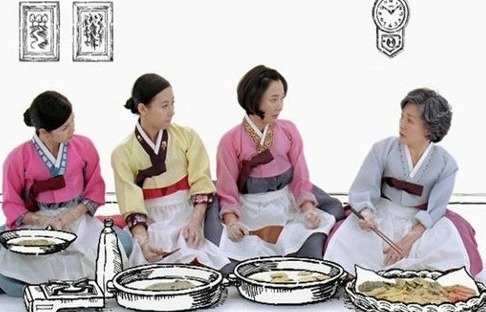
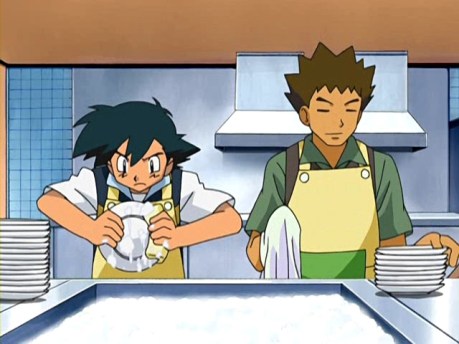
Holiday syndrome was also came from this patriarchal social structure, I think. All the daughters-in-law must go to their mothers-in-law’ houses to prepare food for their ancestors on every Korean holiday. And the problem is that many of husbands (or sons of mother-in-law, father-in-law or any ‘male’ human beings) don’t support, help or assist their wives at all. They think preparation of food for their ancestors are entirely ‘women’s duty’ for a very long time so these husbands never try to help their wives. Also mother-in-law don’t want their sons to work in the kitchen. This is also related to the Korean concept of predominance of man over woman. For this reason, there was a saying that ‘male must not come in the kitchen’. 
1.jpg

daughters in law with a mother in law prepare food
image from <http://blog.daum.net/youngho7995/99>

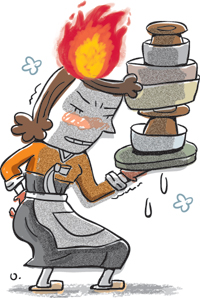
I understand how Korean society had the feudalistic convention of regarding men as superior to women in the past. But the past is past and now is now. We have to change our wrong feudalistic thinking about men and women. Korean holidays are more than worth to enjoy because we can learn our histories, traditions and even ‘Jeong’ with our family and relatives. We are also allowed to think about our ancestors and our roots as well. If our mothers and daughter in law can’t enjoy these holidays, preparing food for other family members can’t be women’s duty any more. It become just women’s stressful work.
110206_18_2.jpg

image from <http://news.kmib.co.kr>

The news reports about holiday syndrome of married women can be seen on TV or in the Internet every year. Our ajummas are suffering from Korean holiday syndrome for many years. The resolution is very simple. Holidays are for everyone. Please do prepare together and enjoy together.

‘Male must come in the kitchen. You’re more than welcome’
297223_8.jpg

image from Pocket Monster, <http://bbs2.ruliweb.daum.net/gaia/do/ruliweb/family/230/read?bbsId=G005&articleId=7994370&itemId=75>

Smartphones for Smart Ajummas

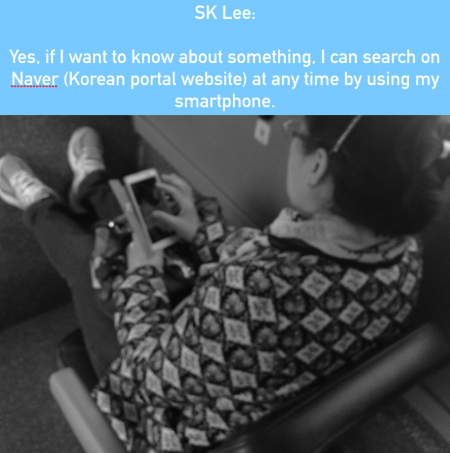
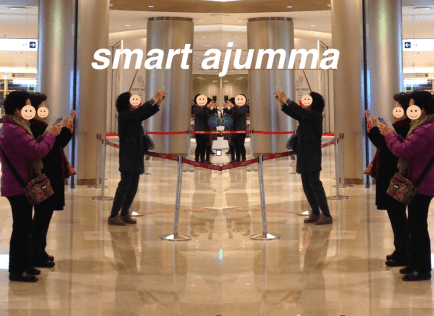
I did focus group interview with 10 ajummas from 2014 to 2015. I asked them ‘How has your life been changed after using smartphones?’ And here are answers of ajummas (aged mid-50 to mid-60). The photos are not related to the interviewees at all. I took photos of ajummas on the street randomly.

Screen Shot 2016-02-04 at 7.06.57 PM

Screen Shot 2016-02-04 at 7.25.23 PM

Screen Shot 2016-02-04 at 7.25.43 PM

Screen Shot 2016-02-04 at 7.25.55 PM


The findings from focus group interview with smart ajummas will be continued via this blog. Thank you.

How did they become Smart Ajumma?

Screen Shot 2016-01-21 at 6.53.44 PM.png

Ajummas are now becoming smarter, especially in the way of they communicate due to their use of new technology in their everyday practices such as smartphones. They are now smart ajummas and becoming smarter constantly according to the development of new technologies. However, it ought not be concluded that smart ajummas are named so only because they use new technology. They also actively attempted to acquaint themselves with new technology in daily lives.

Screen Shot 2016-01-21 at 11.17.15 AM

The penetration of smartphones in Korea is significantly higher than the average in the world and it reach 83 percent as of end-March, according to the data compiled by Digieco (Yonhap News 2015). For me, Korea is like a heaven of smartphone because ‘you can do almost everything with your smartphone’ in Korea. But convenience is not only technology’s best friend, I mean there are always problems to use convenient technology, such as smartphones. Yes, smartphone is a double-edged sword, like the Internet! If you can do almost everything with your smartphones in Korea, this means that you can’t do anything without smartphones. (I won’t talk too much about smartphones because this blog is more about smart ajummas)


Anyway, smartphone is a pervasive mobile communicative devicenow. People use smartphones in their everyday practices regardless age and gender. Ajummas are no exception. There are exact data about penetration rate of smartphone users of middle-aged women in Korea yet, it can be assumed there are increase of using Internet among middle-aged women.

Screen Shot 2016-01-21 at 11.17.22 AM

I know this is not a thesis but I think if I put an actual ‘data’ in this post, it might be powerful to support my idea why I can call ajummas as smart ajummas. I can’t just assume ajummas in Korea became smart ajummas because they use smartphones a lot. So I attached these data which help you to understand my argument (or thought) how I can call ajummas as smart ajumma.

For next post, I will explain in detail why ajummas should be considered as ‘smart ajummas’ today in Korea.

Have a good weekend all ajummas! 모든 아줌마분들! 좋은 주말 보내세요!

Have a good weekend all ajummas!

좋은 주말 보내시길 바랍니다. 우리 아줌마분들!

image

‘Ajumma Locksmith’ in Seoul

‘아줌마 열쇠’ 서울의 한 열쇠가게 이름

Kim Yeo-sa (Mrs. Kim)

Have you heard about Kim Yeo-sa? In the previous post I mentioned about biased views about ajummas (e.g. The Third Gender) I mentioned how ajummas are treated generally in Korea. Kim Yeo-sa is another representative example to show how people have prejudice against ajummas especially for ajumma drivers.

A201206032244296872

(Be Aware an Ajumma!!)

(image from http://gift.kyobobook.co.kr/ht/product/detail?barcode=2310003451616)


Kim Yeo-sa illustrates how ajumma drivers are satirically applied to Korean society. The most ajumma drivers were known and called collectively as Kim Yeo-sa. Kim is the most common surname in Korea and Yeo-sa means Madame in English so Kim Yeo-sa means Mrs. Kim. Various new media reports that Mrs. Kim caused car accidents due to her unskilled driving. However, one thing needs to be considered that there is dispute about the word Mrs. Kim. It is a (sexual) prejudice against female drivers as unskilled and inexperienced compared with male drivers. For example, there is not such a word, Mr. Kim for unskilled and inexperienced male drivers. Moreover, Mrs. Kim is only for middle-aged and married women, ajummas. (The word Mrs. Kim is not used for single and younger female drivers) And even other non ajumma female drivers call ajumma drivers as Mrs. Kim.

HJ Kim:

I’ve been driving for more than 15 years but I still feel scared and expect insults when I drive. I think they (men and non-ajummas) look down ajummas only because we are ajummas. 

RK Hwang:

They just ignored us because we are ajummas. And people don’t care whether we are well experienced drivers or not.

(Focus group Interview from my research)

Ajumma drivers were treated just as Mrs. Kim who are unskilled drivers whether these ajumma drivers are really good at driving or not. People just don’t care about their skills, rather they put ajumma drivers together and dismiss them as Mrs. Kim.

There is an episode about Mrs. Kim when non-ajumma drivers met unskilled Mrs. Kim on the road. They (non-ajumma drivers, mostly male drivers) yelled to Mrs. Kim “Go home and cook dinner instead!!!”

How rude they are!

However, you know ajummas, they are strong and superwomen. They seem undaunted by these biased views about Kim Yeo-sa. Their responses for this are,

Screen Shot 2015-12-29 at 3.27.05 PMScreen Shot 2015-12-29 at 3.27.12 PM

They accepted themselves as Mrs. Kim and they are now trying to improve their driving skills (if they’re unskilled or inexperienced drivers).

Of course some of Mrs. Kim and also Mr. Kim are nuisances on the road. However, we have to remember that all of ajumma drivers should not be considered as Mrs. Kim. Many of ajummas drivers are very good at driving and many of non ajumma drivers are not good at driving as well. Thus, we should have fair-minded about ajumma drivers.


Ajumma is strong!

Whenever I go to the market, I can observe the lives of various types of people. While I am staying in Melbourne or Seoul, going to the market on Saturday is a part of weekly routine for me. Now I more often go to the market since I’ve started doing my PhD research project about ajummas. In the market, I can meet so many types of ajummas who are yelling loudly to sell vegetables or haggling over the price of fruits between seller ajummas and customer ajummas. In addition, it is amazing that snack stall ajummas could remember every order without bills or calculators in the market! And there are strong ajummas who carry heavy shopping baskets for their family.

For last several years and even now, ajummas made contributions to Korean economic development. These ajummas in Korea, they are strong enough to support their family and Korean society.

Screen Shot 2015-12-20 at 9.03.37 PM

Screen Shot 2015-12-20 at 9.03.14 PM

Screen Shot 2015-12-20 at 9.03.49 PM

Screen Shot 2015-12-20 at 9.03.43 PM


Are you ‘ajummarous’?

Screen Shot 2015-12-14 at 4.48.25 PM

(original image from http://www.iworldtoday.com/news/articleView.html?idxno=176220 and I re-edited this image in Keynote)

In most cases, ajummarous women are judged by their appearance.

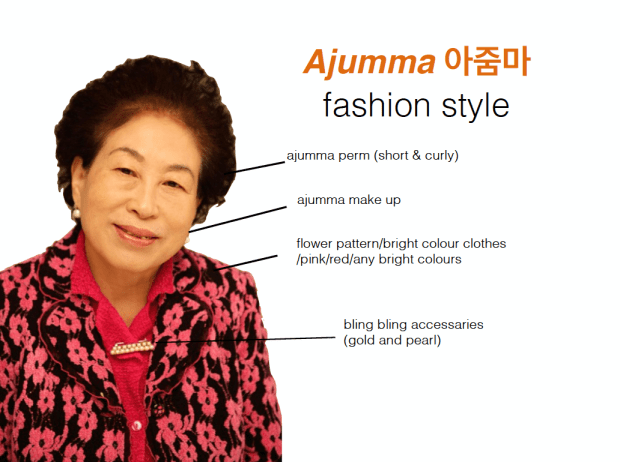
ajumma hair, fashion and make up style

behaviours (way of talking, loud voice, sitting with their legs apart in the subway, being meddlesome)

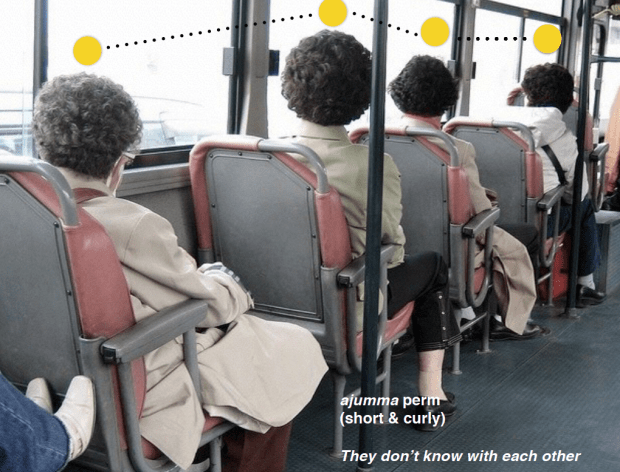
Especially, they are being meddlesome. So if you are in the subway and sitting in the cafe or restaurants, ajummas keep talking to you and even asking some personal questions as well. Whenever I travel on the subway in Seoul, I heard ajummas’ conversations. Interestingly, these ajummas never met with each other before, rather they just met on the subway. Their conversations were about everything, such as cooking, children, weather, culture, politics, etc. It might be strange if strangers talk to you on the subway. However, this is their ways of communication which is very ajummarous ways of communication that exists only in Korea.

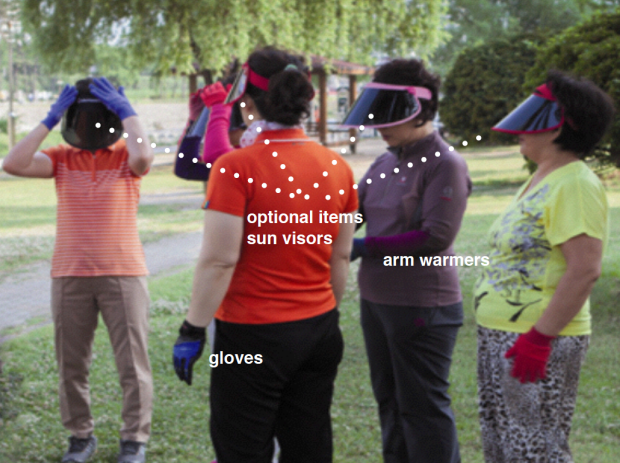
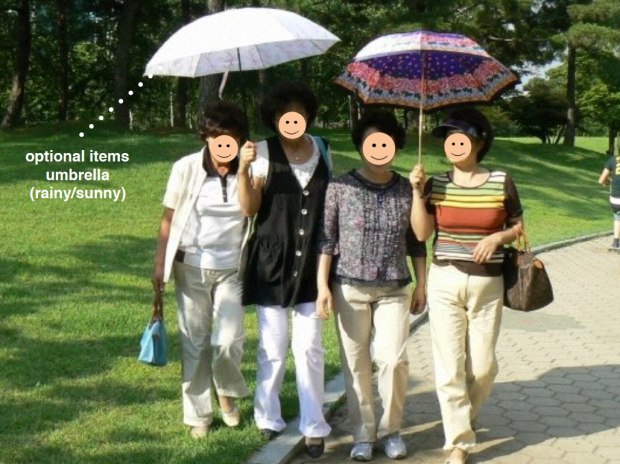
With one of these ajummarous elements (of course there are more ajummarous elements than I mentioned above), any women can be called or recognised as an ajumma in Korea.

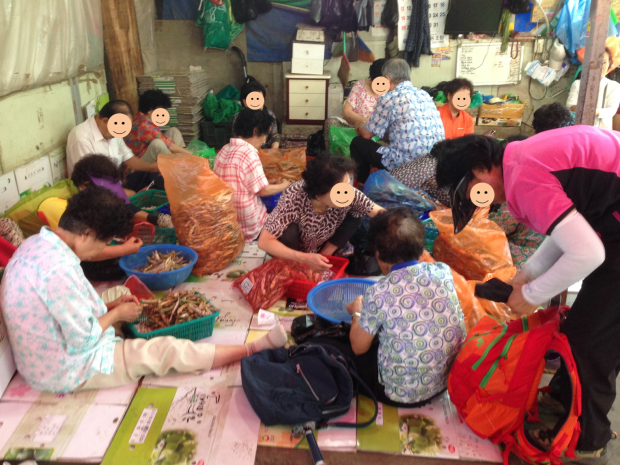
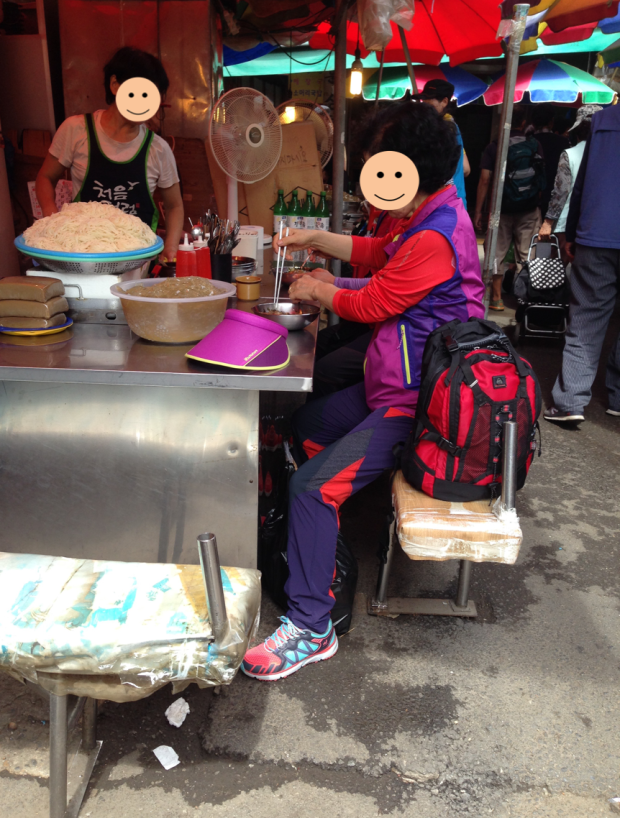
Here are some photos that help you understand what ajummarous elements which define ajummas in general.


Screen Shot 2015-12-14 at 4.56.10 PMScreen Shot 2015-12-14 at 4.56.00 PMScreen Shot 2015-12-14 at 4.55.51 PM