Holiday Syndrome?

Time flies and it’s already February in 2016! Of course we had new year holidays at the beginning of this year, January. However, we (Koreans) have another new year on this coming Monday (8th Feb 2016). From yesterday we’re having a new year holiday until mid of next week. Most people (non-Koreans) think this late new year is called ‘Chinese New Year’. It is so true but we say Korean new year or just Lunar new year. I love holiday (who doesn’t?) especially Korean holidays because I can meet my cousins, aunties, uncles etc. Sadly, my grandma had passed away two years ago so I can’t see her lovely smile any more but still I love to meet my relatives.

Whenever I say I love Korean holidays to my friends especially married ones, all of them told me, “if you are married, you couldn’t love Korean holidays any more, for sure!”. I know what they mean because this is very controversial topic for every Korean woman (especially married women). It is ‘Holiday Syndrome’!

File 6-02-2016, 4 55 21 PM.jpeg

Ajummas in the supermarket to do grocery shopping for Korean New Year 2016

Traditionally, we have a memorial service for ancestors (e.g. great-great-grandparents, great-grandparents, grandparents) on every Korean holiday such as Korean new year, Chuseok (Korean Thanksgiving day) etc. On these holidays, we have to prepare food for ancestral rites table and at the same time for ourselves (family members). This is very good Korean tradition to admire our ancestors on every Korean holiday and relatives could be able to reunite together regularly through enjoying these Korean holidays. However, there is a big problem.

As I mentioned before in my blog post about Women in Korea (2) Before IMF on 11th Jan 2016, Korean society was severe patriarchal society from 1980s to 1990s. Women (mothers, wives, ajummas) had to sacrifice their lives to support husbands and children. This happened in the past and now the society has been changed a lot. Women are also working outside and they push themselves hardly to build their careers. They’re not staying at home to support their family by sacrificing their lives any more. I don’t mean that sacrificing their lives to support husbands and children like our mothers in the past were worthless. I mean the women in today have more opportunities to build their careers than 1980s so they can’t just be a stay-at-home mother rather they should work outside for their careers.

However, the problem is that the social structure and people’s mind haven’t changed a lot. It is like we can do real-time free video chatting through our smartphones  but people still use only voice calling with their high-tech smartphones. Society forces women to build their careers and get higher education but this society doesn’t allow women to be free from their family affairs that the society thinks ‘women’s full time job’. This can be a jump of logic but I think Korea is still very much patriarchal society even though there are so many opportunities for women, especially married women to work outside to build their careers compared with before in 1980s.

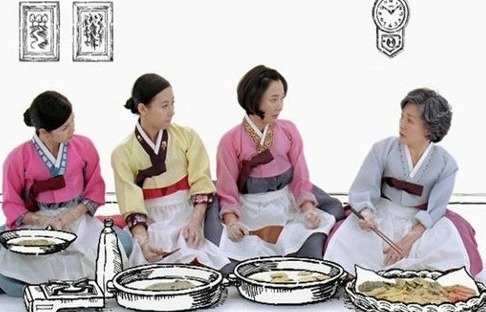
Holiday syndrome was also came from this patriarchal social structure, I think. All the daughters-in-law must go to their mothers-in-law’ houses to prepare food for their ancestors on every Korean holiday. And the problem is that many of husbands (or sons of mother-in-law, father-in-law or any ‘male’ human beings) don’t support, help or assist their wives at all. They think preparation of food for their ancestors are entirely ‘women’s duty’ for a very long time so these husbands never try to help their wives. Also mother-in-law don’t want their sons to work in the kitchen. This is also related to the Korean concept of predominance of man over woman. For this reason, there was a saying that ‘male must not come in the kitchen’. 
1.jpg

daughters in law with a mother in law prepare food
image from <http://blog.daum.net/youngho7995/99>

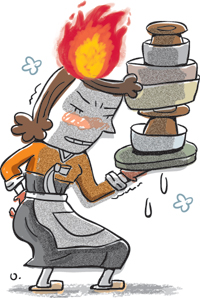
I understand how Korean society had the feudalistic convention of regarding men as superior to women in the past. But the past is past and now is now. We have to change our wrong feudalistic thinking about men and women. Korean holidays are more than worth to enjoy because we can learn our histories, traditions and even ‘Jeong’ with our family and relatives. We are also allowed to think about our ancestors and our roots as well. If our mothers and daughter in law can’t enjoy these holidays, preparing food for other family members can’t be women’s duty any more. It become just women’s stressful work.
110206_18_2.jpg

image from <http://news.kmib.co.kr>

The news reports about holiday syndrome of married women can be seen on TV or in the Internet every year. Our ajummas are suffering from Korean holiday syndrome for many years. The resolution is very simple. Holidays are for everyone. Please do prepare together and enjoy together.

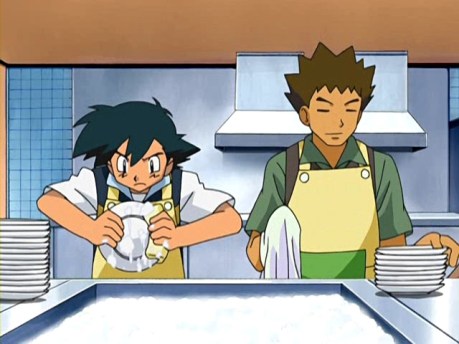
‘Male must come in the kitchen. You’re more than welcome’
297223_8.jpg

image from Pocket Monster, <http://bbs2.ruliweb.daum.net/gaia/do/ruliweb/family/230/read?bbsId=G005&articleId=7994370&itemId=75>

Ajumma day

In this blog, everything is about ajummas because this blog is for ajummas and I really want to share who ajummas are to both Koreans who already knew about ajummas and others who never heard about ajummas before. In the previous blog postings, I  wrote mostly about ajummas who were in pre-smartphone era (times when ajummas didn’t use smartphones, from early-1960s to early-2000s). Now I will talk more about ‘Smart Ajummas’ because that is my biggest concern why I do this blogging and I would like to share ideas and information how Korean ajummas are becoming ‘Smart Ajummas’ and what these ‘Smart Ajummas’ are doing in their everyday lives with the use of smartphones.

ajummaday_blogimg.001.jpeg

Anyway, today I’ll talk about ‘Ajumma Day’ in Korea. Actually I had no idea what ‘Ajumma Day’ was before I’ve been there in 2014. Ajumma day was established in 2000 by one of the biggest website for ajummas azoomma.com and now many of ajummas in Korea love Ajumma day on the 31st May in every year. May is for family month in Korea for example, 5th is Children’s day, 8th is Parents’ day and 15th is Teacher’s day. And the reason why they chose the last day of May as Ajumma day is because Ajummas (mothers at home) are the most important people in every family so they chose the 31st of May (family month).

Sand art for Ajumma Day, 2014


Ajumma Manifesto (I translated from Korean)

As an ajumma in the digital information age of the 21st century, I pledge that I will endeavour to do my best as an independent being for myself, my family as well as the social changing and progress.

  1. I am an independent ajumma who loves myself and recognise the value of my life. I love myself the way I am now and I am proud of myself as an ajumma. I do my best to find the right to live happily as a woman.

  2. I am a leader ajumma who takes care of my family and lead the healthy family  culture creation. I do my best for family life that a wife and a husband loves, understands and helps each other.  Ajumma, as the pillar of the family, I practice from the small thing to create the healthy family culture.

  3. I am an active participant ajumma for social change and progress and I am concerned about neighbours all the time.  I always think about my neighbours beside the family egoism. I show compassion to my neighbours in need and stand valorously against social injustice

  4. I’m a active ajumma who recognise my role in the digital information age and challenge to the new world through the Internet. As a principal agent of home information, I endeavour to do my best to inform my children. I actively embrace new technology and try to use it according to social change and progress.

For the research, I went to Ajumma day in 2014 and I was really impressed. I was more than happy that there is a special day only for ajummas in Korea. And the programs for that day were fully enjoyable and at the same time they gave very useful information for ajummas. Most of all, I think this ajumma day encourages ajummas to be proud of themselves through various actives on that day. Also these ajummas can have opportunities to meet other ajummas who are in the same boat. So ajummas can become one big ajumma group through ajumma day or any other various events for ajummas.

IMG_3615

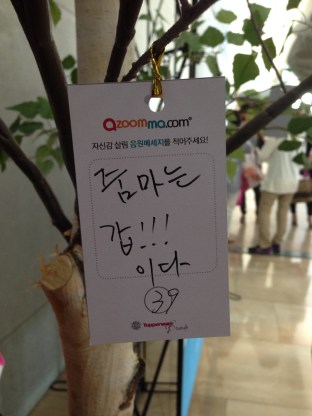
 “Ajumma is the best!!” a message from a wish tree on Ajumma Day, 31st May 2014
IMG_3623
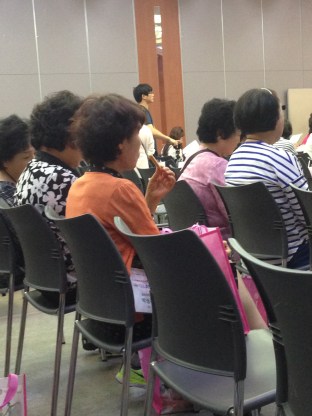
Ajummas on Ajumma Day, 31st May 2014

I enjoyed a lot on Ajumma day in 2014, but I still feel that some more contents or events should be developed and improved more. And I believe it will be getting much better and richer. Further, Ajumma day will be an one of representative days of May in Korea because our ajummas are precious. (:

IMG_3609

A cool Ajumma photographer on Ajumma day 2014

Smart Yakult Ajumma

d0021441_490bb49034d0b

I still remember when I was very young I was more than exciting to drink small bottle of yakult every morning. Since 1971, yakult ajummas delivered yakult to door to door in Korea. These yakult delivery women are called as ‘yakult ajumma’ and they wear uniforms that are similar to the colour of ‘yakult’ which is light pinky apricot. There is no Yakulk Ajeossi (middle-aged men, sort of opposite meaning of ajumma) because the company only hired ajummas for ‘yakult ajumma’. Yes, they do yakult delivery but they are not simply delivery ajummas. They do various social-minded activities to help disadvantaged people such as elder who lives alone, adolescent heads of family etc. As yakult ajumma, they sell yakult to customers but they are more than just ‘yakult delivery women’ rather yakult ajumma as ajummas, they are like our mothers, ajummas who live our next doors. And this friendly and motherly image of ajumma accords with what company aims, for example ‘yakult ajummas deliver health to your door every morning’.

Mother of Working Mom, Yakult Ajumma, YTN TV News, <https://www.youtube.com/watch?v=r1JIYmu33bE>

In the past (1980s to early 2000s), yakult ajummas’ biggest customers are ajummas because they handle the household mostly, so ajummas paid the price of yakult once a month, usually paid by cash to yakult ajumma directly. However, these yakult ajumma changed to smart yakult ajumma since 2013 because they hold hands with digital mobile devices and system.

yakult.001

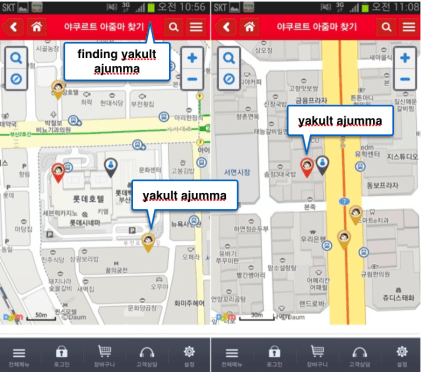
Thus ajumma customers now can order their yakult and pay the price of yakult through using an yakult app on their smartphones. For example, ajumma customers simply put their smartphones on card reader machine of yakult ajumma’s mobile cart, then the money will be charged to their smartphone bill every month. This is convenient for both an ajumma customer and yakult ajumma. In addition, it is innovation of mobile shopping markets because they designed this mobile payment system for the yakult customers, who are the majority of ajummas.

Screen Shot 2016-01-24 at 2.54.37 PM

Screen Shot 2016-01-24 at 2.54.53 PM

image from Yakult365.com <http://yakult365.com/150>

Through this example of yakult ajumma (smart yakult ajumma) and their digital mobile app, I can see how our ajummas engage with mobile digital technology in daily lives. Also these yakult ajummas are using mobile cart and digital technology to sell yakult, their image of yakult ajumma that is ‘friendly and motherly’ still makes customers to feel warmheartedness of yakult ajumma.

Unknown.jpeg

image from Yakult365.com <http://yakult365.com/395>

Actually they tried to change the name of yakult delivery women in 2014. They thought the name of ‘yakult ajumma’ cannot be matched with digital way of yakult ajumma (with mobile cart and smartphone app). So the company invited public participation to create a new name for yakult ajumma. However, people in Korea ask the company for keeping the ‘yakult ajumma’ instead of getting a new funky name for those ajummas. Fortunately, the company keeps ‘yakult ajumma’ and we are able to keep call and see ‘yakult ajumma’ continuously. Yakult ajumma will be staying to deliver health to us everyday but the ways of delivering yakult are evolving constantly as development of new technology. Yes they are now Smart Yakult Ajumma like our Smart Ajummas. Go Ajummas!


Have a good weekend all ajummas! 모든 아줌마분들! 좋은 주말 보내세요!

Have a good weekend all ajummas!

좋은 주말 보내시길 바랍니다. 우리 아줌마분들!

image

‘Ajumma Locksmith’ in Seoul

‘아줌마 열쇠’ 서울의 한 열쇠가게 이름

Women in Korea (3) IMF 1997

We had IMF in 1997. IMF (International Monetary Funds), this economic crisis leads to the “reversal of traditional gender roles and endangered the stability of the patriarchal nuclear family system” (Kim 2008, p.392). Due to the worsening of economic conditions, women had to come out of the houses to work rather than being good mothers and wives at home. They had to be good mothers and wives at home and at the same time, these women had to work outside of home to earn money. In other words, women in Korea during IMF, they became breadwinners as well. However, most ajumma were part time  lower-paid workers such as cashers at supermarkets.

Screen Shot 2016-01-15 at 4.23.54 PM

image from the movie ‘Cart (2014)’, <http://www.asiae.co.kr/news/view.htm?idxno=2014103011094055036>

Even though they were part time workers who got low pay, they worked really hard because they believed that the improvement of each family’s economic condition can be a cornerstone of Korea’s economic growth. People in Korea during IMF, they tried to overcome the IMF together. However, still it blew to every family’s economy. In May 1998, more than 80% of households in Korea suffered very much in the reduction of income. Fathers lost their jobs so they could not fulfil the role of fathers and husbands in their family.

1101_b084_8.jpg

image from Monthly Chosun <https://monthly.chosun.com/client/news/viw.asp?nNewsNumb=201101100071>

In 1998, there were 42% increase of suicide rate compared to the previous year. Male had higher percentage than female in the report. It could be assume that fathers couldn’t able to do their duties to their families because of unemployments and crippling debts. Therefore, mass media encourages people to recognise the importance of their fathers in the family. For example, “save the head of the family”, “encourage men” and “support and cheer up our fathers”. Besides, people do various campaigns for the nation and gold collection was one of them. I will post about ‘gold collection’ campaign soon.


TV Commercial in 1997 by KIA motors “We can do it!”

Reference: (1) Kim, S 2008, ‘Feminist Discourse and the Hegemonic Role of Mass Media’, Feminist Media Studies, vol. 8, no. 4, pp. 391-406.


Digital swish of skirt

In the previous post, I talked about ‘Women in Korea (2)-1: swish of skirt in 1980s’. This education fever still remains in Korean society but mothers (ajummas) today followed different ways that I called ‘digital swish of skirt’. Compared with non-smartphone era which is from 1980s to early 2000, the use of smartphones change our life styles in many ways likewise the enthusiasm of education among ajummas. This means that ajummas could be able to get involved in supporting their children’s education easily through using their smartphones. There are various apps that helps mothers (ajummas) to share useful information about their children’s education for example, “Which Hak-won (private educational institution) do you go?“. This app provides people’s various opinions and useful information about private educational institutions for parents and their children. So it helps both parents and their children to choose better private educational institutions. This app determines the ranking of private educational institutions according to the actual statistical data. Parents can ask questions or answer others’ questions interactively through using app on their smartphones in real time.

Screen Shot 2016-01-13 at 7.42.07 PM.png

There are many types of apps for parents who concern their children’s education in Korea. I cannot enumerate every app in this blog but one thing that I can say is these types of apps for parents are increasing significantly. The term ‘swish of skirt’ is not used broadly today but I can see the swish of skirt phenomena still remains today. I call it ‘Digital swish of skirt’. Ajummas (mothers) are overly involved in their children’s education today through using education related apps on their smartphones. They becomes smart ajummas.

Women in Korea (2)-1 Swish of skirt in 1980s

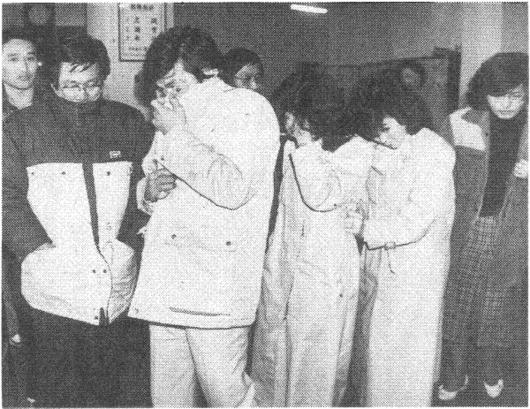
The ‘swish of skirt’ means that mothers are getting overly involved in the schooling for their children. During the 1980s swish of skirt phenomena was serious social problem in Korea. Some mothers move into areas concentrated with of private academic educational institutions such as Gang Nam School District 8. Also the expensive private lessons were prevalent in that area so Korean government conducted crackdown people who were related to those expensive private lessons.

9750aae7f9654f8eb10655cb80a79e87

Tutors who were involved in the expensive private lessons were brought to the police station in 1988
image from Kyung Hyang Newspaper, <http://news.zum.com/articles/25543690>

Mothers in 1980s, they thought that entering their children to good university (SKY, Seoul University, Korea University, Yonsei University) is their goal and duty as mothers because mothers believed that qualification (especially graduating a good university) determines their children’s lives.

43themes3_bg03.jpg

Mothers (ajummas) waited and prayed for their children to pass a university entrance examination withough leaving while students were taking the exam.
image from: Samsung & You Premium, <https://www.samsungnyou.com/7486/>


This education fever of South Korean mothers was continuously overheated to make their children entering the good universities. Thus, Korea stands the first regarding domestic expenses on education in the world. Since 1980s, women in Korea playing both roles, “professional mother” and “professional housewives”. They are like a superwomen. As I mentioned before, ajummas are superwomen.

We still have education fever and ajummas of course still concern their children’s education. For example, there are Helicopter mothers and Kangaroo mothers. They are overly involved into not only their children’s education, but also their private lives (e.g. hobby, a network of friends, jobs and even marriage).

365_331_2817

image from <http://www.opnews21.com/news/articleView.html?idxno=365>

6989811.1

 image from <http://news.donga.com/3/all/20061121/8375428/1>

But I think the way of ‘swish of skirt’ changes into sort of ‘digital swish of skirt’ in these days. In other words, mothers (ajummas) in these days became smart for their children’s education. This means that many of ajummas (mothers) use their smartphones to search information and useful sources for their children’s education. I will talk about ‘Digital swish of skirt’ in next post.

Women in Korea (2) Before IMF

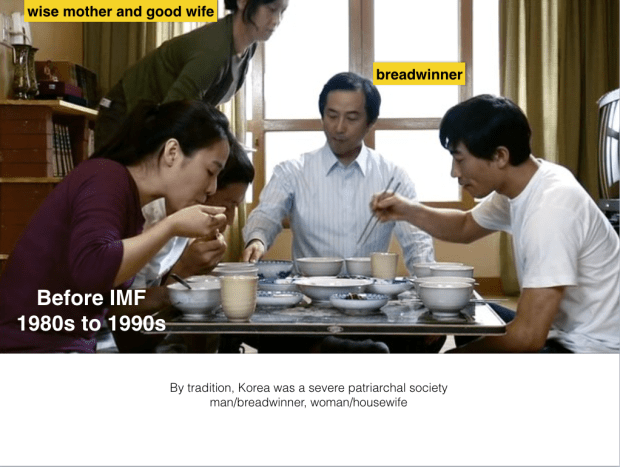
As I mentioned in the previous post, women in Korea after the Korean War during 1960s to 1970s (of course women workers were still working hard in 1980s as well) made a significant economic growth. After that period,  the majority of middle-aged males led the remarkable economic growth in manufacturing especially 1970s to 1980s. Men as breadwinners and women as housewives were considered as a matter of course. Thus becoming a full time housewives was a common thing after marriage for women and being a ‘wise mother and good wife’ was dreaming image for married women in Korea at that time. Most married women during 1980s had to quit their jobs because they had less opportunity to work in the company compared with married men.

Screen Shot 2016-01-11 at 1.22.16 PM.png

Married women became ‘wise mother and good wife’ to raise their children and support husbands at home, whereas married men’s duty was ‘working hard to support their family’ as breadwinners. So Korean men worked the longest hours in the world because they had to work from early morning to midnight and even during the weekends. For this reason, most Korean families became ‘father-absent and mother-involved’ family.

2015112100644_0.jpg

Screen Shot 2016-01-11 at 1.38.37 PM.png

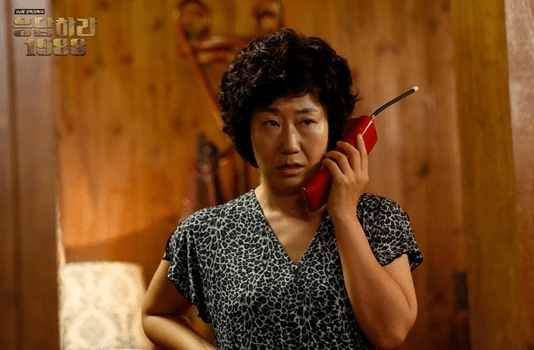
(image from ‘Reply 1988′ tvn http://program.interest.me/tvn/reply1988)

Role of mothers is increasingly significant for their children because most families were ‘father-absent and mother-involved’. At the same time, mothers made sacrifices for their children and they especially gave full support of their children’s education.

(This can’t be explained simply but I can assume that most Korean mothers were not working outside home at that time so they put their heart and soul into educating their children. They believed that entering good universities were the most important thing for their children in Korean society)

So ‘the swish of skirt’ was occurred among mothers in 1980s and 1990s. And it still remains. I will write about ‘the swish of skirt’ for next posting.


Ajumma is FAST! 아줌마는 빠르다!


Here is a TV commercial that describes how fast ajummas are. In this TV commercial, they emphasises that their LTE service is faster than ajummas in the subway. This means they’ve provided the fastest LTE service in Korea. In reality, ajummas are faster than Usain Bolt in the subway, for sure.

지금 보여지는 이 광고는 아줌마가 얼마나 빠른지에 대해서 보여주고 있다. 이 광고를 통해, 그들이 제공하는 LTE 서비는 아줌마보다 빠른, 즉 대한민국에서 가장 빠른 LTE서비스를 제공하고 있다는 것을 강조하고 있다. 진짜로 대한민국 아줌마들은 지하철에서만큼은, 우사인 볼트보다 빠르다! 정말로!


Women in Korea (1) 1970s

To talk about women in Korea is not easy and  complicated to explain in this blog post. However, one thing that I can say is Korean women became  great power to support whenever we have difficulties and they were backbone of the growth of Korean economy. So I will write about ‘Women in Korea’ and I categorised by chronological order because ‘Women in Korea’ is a big topic to write in one post.

(1)1970s (After the Korean War)

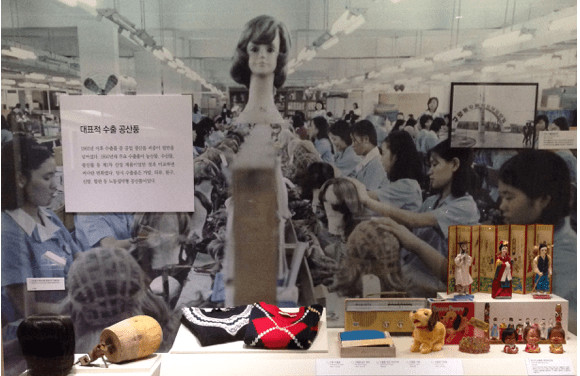
Screen Shot 2016-01-07 at 12.28.16 PMWomen in Korea, they have contributed to the country’s economic development. Just after the Korean War during 1950s to 1970s, large numbers of female factory workers made a significant contribution to export-led industrialisation. Today, there are so many things or almost everything is made in China, but during that time, especially 1970s made in Korea products were famous in the world. One of my aunty lives in the USA and she said that many of made in Korea products were easily found such as stuffed dolls (e.g. teddy bear), wigs, socks, etc.
Screen Shot 2016-01-07 at 12.38.03 PM.png

Representative Exports during 1960s-1970s (taken in Seoul Museum of History)

Young girls worked in the factory instead of going to schools because they had to earn money for their family. They stayed in the factory dormitory and worked all day. Those young girls are now became ajummas today and they are aged over 60s like my mother’s generation.

Screen Shot 2016-01-07 at 12.28.26 PM

I will talk about ‘Women in Korea (2) Before IMF (International Monetary Funds)’ for next post.

Ajumma vs Nuna (older/big sister)

It’s 2016!

I start blogging since last December as a part of my PhD project, ‘Smart Ajumma’. In this blog, I would like to introduce various photos of ajummas in Korea and the blog posts are more similar to written records like diary rather than academic thesis. I hope people in Korea and anywhere get chances to comprehend who ajummas are and redefine what ajummas are through having interactive communication on this blog for example making comments. So please come to this blog often and feel free to share your ideas about ajummas or Korea. Happy New Year again!

I went to Namdaemun Market today. Namdaemun Market is always my favourite to visit since I was very young (with my mum). There are small old shops in every alley ways and especially I loved to buying some imported snacks (e.g. sweets from USA) in Namdaemun. These days I can find them everywhere but it was rarely sold when I was very young.

Going to Namdaemum Market is not difficult by public transport (e.g. bus) from my town. Whenever I go to Namdaemun Market, I can have a chance to visit variety of shops in Myeong-dong because they are located close with each other. In addition, I can see many ajummas in Namdaemun Market especially a small shopping mall that is called ‘Common Plaza’. They sell mostly women’s clothing especially for middle-aged women, ajummas, whose age range is around over 50. Whenever I visit there, I never seen a male or a  younger female customer except me.

In that shopping mall (it is located in Namdaemun Market), I feel like I’m visiting an island of ajummas. It looks like someone bring all of those ajumma customers from somewhere (special planet) we never been before. So many ajummas with having similar hair styles, fashion styles and even body figures! (similar height etc.)

Screen Shot 2016-01-04 at 6.40.21 PM

Screen Shot 2016-01-04 at 6.40.15 PM

Unfortunately, I couldn’t see many ajummas today because the weather wasn’t good and I arrived there almost at closing time (1:30 pm). For this reason, I headed to the street stall where it sells red bean porridge nearby that shopping mall. There are no table neither chair but customers still can enjoy their porridge. And most customers of this porridge stall are ajummas. Thus, I brought my porridge and leaned against the wall like other ajummas also do.

Then, a young male was selling cosmetics to those ajummas who were having red bean porridge. Those ajummas looked like over 50 and 60 years old. That young male seller said,

“Nuna! (older/big sister) You have pretty face! Why don’t you concern ‘skin care’ with this product! I guarantee you will be look like 10 years younger than your actual age with using this product!”

Ajummas were laughing together and one of them bought a facial cream from him. This ajumma asked the young male seller taking a selfie together and they took a photo with her smartphone. (Well, that young male seller is a lesser-known comedian so this ajumma wanted to take a selfie together). After selling a facial cream to one of ajummas, he left that place and said to ajummas,

“Nuna! I hope to see you all for next time again!”

Ajummas continued to eat red bean porridge and talked about that comedian who sold cosmetics few minutes ago. I really enjoyed that situation as an observer. How amazing this situation is! The ajummas and a young male seller who wanted to sell cosmetic products to ajummas! He called ajummas as ‘Nuna!’ instead of ‘Ajumma!’ and those ajummas were happy to be called as ‘Nuna!’ rather than ‘Ajumma’.

Yes, ajummas are women. If he call them, “Ajumma!”, was he still able to sell the facial cream? I think these ajummas felt happy because that young male seller call them as ‘Nuna’. Of course these ajummas know this young male seller call them as ‘Nuna’ because he tried to make these ajummas happy as a sort of marketing strategies. However, ajummas still enjoy that moments through communicating with other ajummas and a young male seller.

Why ‘ajumma’ became an unwelcome word to be called among women in Korea?

Screen Shot 2016-01-04 at 6.40.26 PMScreen Shot 2016-01-04 at 6.40.33 PM

Screen Shot 2016-01-04 at 6.40.05 PM

Kim Yeo-sa (Mrs. Kim)

Have you heard about Kim Yeo-sa? In the previous post I mentioned about biased views about ajummas (e.g. The Third Gender) I mentioned how ajummas are treated generally in Korea. Kim Yeo-sa is another representative example to show how people have prejudice against ajummas especially for ajumma drivers.

A201206032244296872

(Be Aware an Ajumma!!)

(image from http://gift.kyobobook.co.kr/ht/product/detail?barcode=2310003451616)


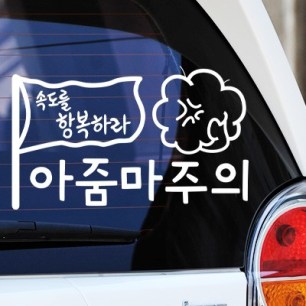
Kim Yeo-sa illustrates how ajumma drivers are satirically applied to Korean society. The most ajumma drivers were known and called collectively as Kim Yeo-sa. Kim is the most common surname in Korea and Yeo-sa means Madame in English so Kim Yeo-sa means Mrs. Kim. Various new media reports that Mrs. Kim caused car accidents due to her unskilled driving. However, one thing needs to be considered that there is dispute about the word Mrs. Kim. It is a (sexual) prejudice against female drivers as unskilled and inexperienced compared with male drivers. For example, there is not such a word, Mr. Kim for unskilled and inexperienced male drivers. Moreover, Mrs. Kim is only for middle-aged and married women, ajummas. (The word Mrs. Kim is not used for single and younger female drivers) And even other non ajumma female drivers call ajumma drivers as Mrs. Kim.

HJ Kim:

I’ve been driving for more than 15 years but I still feel scared and expect insults when I drive. I think they (men and non-ajummas) look down ajummas only because we are ajummas. 

RK Hwang:

They just ignored us because we are ajummas. And people don’t care whether we are well experienced drivers or not.

(Focus group Interview from my research)

Ajumma drivers were treated just as Mrs. Kim who are unskilled drivers whether these ajumma drivers are really good at driving or not. People just don’t care about their skills, rather they put ajumma drivers together and dismiss them as Mrs. Kim.

There is an episode about Mrs. Kim when non-ajumma drivers met unskilled Mrs. Kim on the road. They (non-ajumma drivers, mostly male drivers) yelled to Mrs. Kim “Go home and cook dinner instead!!!”

How rude they are!

However, you know ajummas, they are strong and superwomen. They seem undaunted by these biased views about Kim Yeo-sa. Their responses for this are,

Screen Shot 2015-12-29 at 3.27.05 PMScreen Shot 2015-12-29 at 3.27.12 PM

They accepted themselves as Mrs. Kim and they are now trying to improve their driving skills (if they’re unskilled or inexperienced drivers).

Of course some of Mrs. Kim and also Mr. Kim are nuisances on the road. However, we have to remember that all of ajumma drivers should not be considered as Mrs. Kim. Many of ajummas drivers are very good at driving and many of non ajumma drivers are not good at driving as well. Thus, we should have fair-minded about ajumma drivers.