아줌마 이미지를 Pixcel이라는 앱을 통해 만들어 보았습니다. 다음에는 좀 더 정교하게 한 번 더 만들어 볼께요. 아줌마 화이팅!
I tried to make an animated ajumma by using an app called ‘Pixcel’ on my smartphone. I will try better ‘ajummarous animated image’ for next time. Ajumma Fighting!
1997년, 대한민국은 금융위기를 맞았다. IMF (International Monetary Funds)로 인해 대한민국의 경제는 돌이킬 수 없을 정도로 힘들어졌고, 이러한 경제위기는 “전통적인 성역할과 가부장적인 핵가족 중심의 사회에 큰 변화를 가져오는 계기가 되었다” (김 2008, p. 392). 경제가 악화됨에 따라서 당시의 여성들은 더이상 현모양처로만 있을 수 없게 되었다. 즉, 자녀양육과 가정을 돌보던 ‘전통적인 여성’의 모습에서 벗어나 가족을 위해 집밖에서도 일을 해야하는 ‘가장’의 역할까지 동시에 해야만 했던 것이다. 따라서 당시의 우리 아줌마들 (엄마들, 어머니들)은 집안과 집밖을 동시에 돌봐야하는 정말 힘든 시기를 겪을 수 밖에 없었다. 그들 대부분이 했던 일은 비정규직의 저임금 파트타임 일들 이었고, 이는 대부분 마트에서 짐을 옮기거나, 물건을 파는 일 혹은 계산원 같은 고된 일들이었다. 하지만 대부분의 아줌마들은 가족과 더 나아가 나라를 위해 그러한 힘든 일들을 마다않고 묵묵히 해내었다.
우리의 아줌마들은 그렇게 일하는 것이 가족을 위한 그리고 더 나아가 나라의 경제를 다시 살릴 수 있는 기회가 될 것이라고 굳게 믿었고 따라서 집안에서 가정으로 돌보고 집밖에서는 워킹맘으로 일을 하며 다함께 경제위기를 극복하고자 했다. 1997년과 1998년 동안의 경제위기 동안, 대한민국의 모든 사람들은 열심히 일을 했다. 하지만 여전히 삶은 고달프고 힘들었다.
1998년 5월, 80%가 넘는 가정의 임금이 삭감되었고, 또한 대부분의 가정의 가장은 실직을 하게 되었다. 한 가정의 경제를 책임지고 있었던 가장의 실직은 가족을 힘들게 하였고 또한 가장 자신도 가장의 역할을 제대로 해 낼수 없는 것에 대해 고통스러워 했던, 대한민국 모두가 매우 힘든 시기를 겪고 있었다.
1998년, 자살율이 전년도에 비해서 42%나 높아졌고, 남성의 자살율이 여성보다 현저히 높았던 것으로 조사 되었다. 이를 통해서 추측하건데, 아마도 그 당시의 우리 아버지들이 임금삭감과 실직으로 인해 가장으로서의 역할을 제대로 해내지 못한것에 대해 그러한 결정을 내리게 된게 아닐까 하고 조심스럽게 생각해 본다. (통계 자료에는 정확한 사유가 나와있지 않았다)
이렇게 국민 모두가 힘들어하던 IMF시기에, 각종 미디어는 다양한 캠페인과 공익 광고를 내놓아 국민들의 사기를 북돋기 위해 힘을 썼다. 특히, 아버지들을 위한 캠페인들이 쏟아져 나왔다. (어머니들에 대한 차별이라기 보다 그 당시 대부분의 ‘가장’이었던 우리네 아버지들의 실직등으로 인해 아버지를 위한 캠페인이 좀 더 나오게 된 것이다) 이 뿐 아니라, 경제위기 극복을 위한 캠페인이 행해졌는데 그 한 예로 ‘금 모으기 운동’을 반드시 얘기해야 할 것이다. ‘금 모으기 운동’에 대한 글은 다음 포스팅에서!
1997년 기아자동차 TV광고 “우린 할 수 있어요!”
참고문헌: (1) Kim, S 2008, ‘Feminist Discourse and the Hegemonic Role of Mass Media’, Feminist Media Studies, vol. 8, no. 4, pp. 391-406.
We had IMF in 1997. IMF (International Monetary Funds), this economic crisis leads to the “reversal of traditional gender roles and endangered the stability of the patriarchal nuclear family system” (Kim 2008, p.392). Due to the worsening of economic conditions, women had to come out of the houses to work rather than being good mothers and wives at home. They had to be good mothers and wives at home and at the same time, these women had to work outside of home to earn money. In other words, women in Korea during IMF, they became breadwinners as well. However, most ajumma were part time lower-paid workers such as cashers at supermarkets.
Even though they were part time workers who got low pay, they worked really hard because they believed that the improvement of each family’s economic condition can be a cornerstone of Korea’s economic growth. People in Korea during IMF, they tried to overcome the IMF together. However, still it blew to every family’s economy. In May 1998, more than 80% of households in Korea suffered very much in the reduction of income. Fathers lost their jobs so they could not fulfil the role of fathers and husbands in their family.
In 1998, there were 42% increase of suicide rate compared to the previous year. Male had higher percentage than female in the report. It could be assume that fathers couldn’t able to do their duties to their families because of unemployments and crippling debts. Therefore, mass media encourages people to recognise the importance of their fathers in the family. For example, “save the head of the family”, “encourage men” and “support and cheer up our fathers”. Besides, people do various campaigns for the nation and gold collection was one of them. I will post about ‘gold collection’ campaign soon.
TV Commercial in 1997 by KIA motors “We can do it!”
Reference: (1) Kim, S 2008, ‘Feminist Discourse and the Hegemonic Role of Mass Media’, Feminist Media Studies, vol. 8, no. 4, pp. 391-406.
In the previous post, I talked about ‘Women in Korea (2)-1: swish of skirt in 1980s’. This education fever still remains in Korean society but mothers (ajummas) today followed different ways that I called ‘digital swish of skirt’. Compared with non-smartphone era which is from 1980s to early 2000, the use of smartphones change our life styles in many ways likewise the enthusiasm of education among ajummas. This means that ajummas could be able to get involved in supporting their children’s education easily through using their smartphones. There are various apps that helps mothers (ajummas) to share useful information about their children’s education for example, “Which Hak-won (private educational institution) do you go?“. This app provides people’s various opinions and useful information about private educational institutions for parents and their children. So it helps both parents and their children to choose better private educational institutions. This app determines the ranking of private educational institutions according to the actual statistical data. Parents can ask questions or answer others’ questions interactively through using app on their smartphones in real time.
There are many types of apps for parents who concern their children’s education in Korea. I cannot enumerate every app in this blog but one thing that I can say is these types of apps for parents are increasing significantly. The term ‘swish of skirt’ is not used broadly today but I can see the swish of skirt phenomena still remains today. I call it ‘Digital swish of skirt’. Ajummas (mothers) are overly involved in their children’s education today through using education related apps on their smartphones. They becomes smart ajummas.
치맛바람! 요즘에는 많이 쓰진 않지만 1980년대에는 많이 쓰였던 말이다. 엄마들이 자녀의 교육을 위해 학교와 사설 학원등을 다니며 관여하는 것을 빗대어 ‘치맛바람을 일으키며 다닌다’ 라고 그 당시 극성 엄마들의 행태를 비꼬아서 부르던 말이다. 지금도 한국엄마들의 교육열은 대단하지만 1960년대 이후 부터 엄마들의 교육열은 엄청났었다. 1980년대 전두환 정권에서 과외금지령이 내려졌을 정도로 사교육은 단순히 ‘교육열’을 넘어선 사회문제가 될 정도였으니까.
강남 8학군의 학교에 보내기 위해 주소지 변경, 이사 등은 말 할 것도 없었고, 이로 인해 강남 8학군의 학교들은 학생들로 넘쳐났다. 지금이야 없어진 모습이지만 그 당시의 엄마들은 소위 말하는 ‘SKY (Seoul대학교, Korea 고려 대학교, Yonsei 연세 대학교)에 보내기 위해 강남 8학군으로 가야한다는 생각을 가지고 있었다. 사실 나는 어려서 기억을 잘 하진 못하지만 내 큰 어머니도 강남의 8학군으로 자녀들을 보내기 위해 어린 사촌 오빠들을 데리고 이사를 간 ‘극성엄마’ 였었다. 물론 강남 8학군 효과는 그리 크진 못했지만.
그 당시의 엄마들은 (아줌마들) 좋은 대학이 편안하고 성공한 인생을 보장해 준다고 믿고 있었다. 사실 지금도 ‘좋은 대학’ 은 ‘성공한 인생’ 이라고 보는 시각이 여전하긴 하다. 물론 일부. 따라서 ‘좋은 스펙’을 따기 위해 모든 걸 다 바쳐, 그게 불법 고액 과외라고 할지라도, 좋은 대학에 보내야 하는게 엄마로서의 도리였고 역할이자 꿈 이었던 것이다. 내가 대학에 갈 때는 불법 과외같은 건 없었지만 (암암리에 있었을지도) 쪽집게 과외라고 불리우는, 시험에 나오는 것만 쪽집게처럼 뽑아서 알려준다는 과외, 것을 주위 몇몇 친구들이 하기도 했었다.
1980년대의 대학입학 시험장 풍경. 지금도 그렇지만 엄마들은 자녀의 시험이 치뤄지는 동안 내내 저렇게 교문앞에 서서 기도를 했다. 힘든것도 추운것도 모른 채, 그렇게 계속 기도를 했다.
이러한 한국 엄마들의 교육열은 시대가 많이 변한 지금도 여전하다. 좋은 대학에 보내기 위해 유치원때부터 엄마들의 교육열은 시작되고, 그 방식은 예전보다 좀 더 체계적이고 ‘스마트’해지고 있다. (스마트 해졌다는 것은 지금의 엄마들은 스마트기기들을 통해 유용한 정보를 공유하고 습득한다는 것을 말한다) 하지만 역시 과도한 교육열을 가진 ‘헬리콥터 맘’ 이나 ‘캥거루 맘’ 들은 자녀들의 삶에 너무 깊게 관여해서 오히려 역효과를 가져올 수 있다고 생각한다. 자녀들이 자신들의 삶을 잘 살 수 있도록 옆에서 조언을 해주고 도움을 주는 ‘힌트’를 주는게 아니라, 바로 ‘정답’을 알려주다 보니 자녀들은 ‘부모가 원하는 삶’을 살고 있게 되는 것이다.
1980년대 이래로, 한국의 여성들은 “프로 엄마” 그리고 “프로 주부”의 역할을 동시에 해내고 있다. 이전의 글에서 말했던 것처럼 우리의 엄마, 아줌마들은 ‘수퍼우먼’이다. 모든것을 다 해내는 수퍼우먼. 하지만 나는 이 프로젝트를 통해서 한국의 여성, 특히 아줌마들이 단순히 ‘프로 엄마’ 혹은 ‘프로 주부’의 역할을 하는 수퍼우먼이 아닌, 아줌마로서의 삶, 여성으로서의 삶을 즐기고 있음을 사람들에게 알려주고 싶다. 여성은 엄마 혹은 주부 (아내)가 아닌 하나의 ‘인간’으로서 살고 있음을 보여줄 것이다.
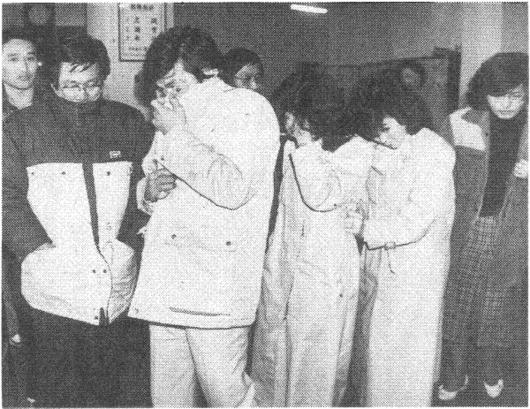
The ‘swish of skirt’ means that mothers are getting overly involved in the schooling for their children. During the 1980s swish of skirt phenomena was serious social problem in Korea. Some mothers move into areas concentrated with of private academic educational institutions such as Gang Nam School District 8. Also the expensive private lessons were prevalent in that area so Korean government conducted crackdown people who were related to those expensive private lessons.
Tutors who were involved in the expensive private lessons were brought to the police station in 1988
Mothers in 1980s, they thought that entering their children to good university (SKY, Seoul University, Korea University, Yonsei University) is their goal and duty as mothers because mothers believed that qualification (especially graduating a good university) determines their children’s lives.
Mothers (ajummas) waited and prayed for their children to pass a university entrance examination withough leaving while students were taking the exam.
This education fever of South Korean mothers was continuously overheated to make their children entering the good universities. Thus, Korea stands the first regarding domestic expenses on education in the world. Since 1980s, women in Korea playing both roles, “professional mother” and “professional housewives”. They are like a superwomen. As I mentioned before, ajummas are superwomen.
We still have education fever and ajummas of course still concern their children’s education. For example, there are Helicopter mothers and Kangaroo mothers. They are overly involved into not only their children’s education, but also their private lives (e.g. hobby, a network of friends, jobs and even marriage).
But I think the way of ‘swish of skirt’ changes into sort of ‘digital swish of skirt’ in these days. In other words, mothers (ajummas) in these days became smart for their children’s education. This means that many of ajummas (mothers) use their smartphones to search information and useful sources for their children’s education. I will talk about ‘Digital swish of skirt’ in next post.
한국여성에 관해 시간순서대로 짧게 요약해서 이야기하고 있는 두 번째 포스팅이다. 한국전쟁 직후의 여성들은 전쟁 직후의 나라와 가족을 위해 어린 여학생들 까지도 공장에 다니며 돈을 벌었고 한국경제를 살려내는데에 주축이 되었었다. 그 이후 1980년대와 1990년대에는 중년 남성들이 주축이 되어 현저한 경제성장을 이룩하는데에 큰 힘을 보태었다. 특히 제조 부분의 수출이 급성장 하게 되었고 한국의 경제는 안정을 찾기 시작하게 되었던 것이다. 물론 1980년대에서 1990년대에도 열심히 일하는 여성들이 있었지만 이 시기에는 대부분의 기혼 여성들은 결혼 후에 직장을 그만두고 가정에서 아내로 그리고 엄마로서의 역할에 더 충실하게 되었다. 다양한 이유가 있었겠지만 그 당시의 기혼 여성들은 결혼 후에 퇴사를 해야하는 경우가 대부분 이었고, 따라서 본인의 의지에 따라 혹은 본인의 의지에 상관없이 상당수의 기혼 여성들은 (모두가 아닌) ‘현모양처’를 꿈꾸며 엄마와 아내의 역할을 이어나가게 되었다.
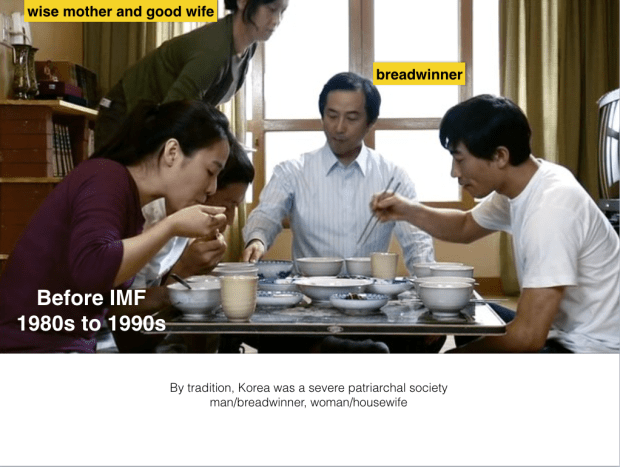
이에 반해, 기혼 남성들은 거의 대부분이 밖에서 일을하며 가정의 경제적인 부분을 책임지는 ‘가장’이 되었다. 즉 1980년대와 1990년대의 가족의 모습은 ‘남성’은 가장이 되고 ‘여성’은 현모양처가 되는 전형적인 가부장적 가족이 대부분이었다. 따라서 여성은 집안에서 ‘힘든 집안일과 육아’를 도맡아 해야 했고, 남성은 집밖에서 ‘가족의 생계를 책임’질 수 있도록 열심히 일해야 했다.가족의 생계를 위해 아침일찍 출근해서 야근은 기본으로 자정이 훌쩍 넘어서야 집에오고 또 주말에도 일을 하러 나가야 했던 ‘아버지’들을 통해서 왜 한국남성이 전세계에서 가장 일을 많이 하는 집단으로 조사가 되었는지를 잘 알 수 있다. 이로 인해 집안일과 육아는 오롯이 ‘엄마’의 몫이었고, 한국의 가정은 아버지가 빠지고 어머니가 주도하는 가족의 모습으로 바뀌어 갈 수 밖에 없었다. 자녀들과 어머니는 그들의 아버지와 남편을 볼 기회가 매우 적었고, 가정에서 일어나는 모든일은 여성이 혼자 감당해내야 했었다. 가정의 일이라는게 단순히 육아와 집안일만 있는것이 아니기에 대한민국의 어머니들, 즉 기혼 여성들은 점점 강해져 갈 수 밖에 없었고 자녀들은 그런 어머니에게 점점 더 의지하게 된 것이다.
집안에서 어머니의 역할은 ‘엄마와 아빠’의 두 역할을 해야했고, (물론 아버지 또한 가족의 생계를 위해서 일을 해야했기 때문에 가족과의 시간을 보낼 시간이 부족했었다. 이는 아버지의 탓이 아니다) 특히 어머니들은 자녀의 교육에 힘을 쏟았다. 소위 ‘극성 엄마’가 된 그 시대의 (여전히 지금도) 어머니들이 왜 그렇게 자녀교육에 힘을 쏟았는 지는 다양한 시각으로 설명이 될 수 있다. 내가 리서치를 통해서 짐작해 볼 수 있는 것은, 그 당시의 어머니들은 ‘좋은 대학에 들어가는것’이 그 무엇보다 가장 중요한 것이라고 믿었고 또한 남편의 부재에 따라 (회사일로 인해서 바빴던 그 당시의 아버지들) 가정과 육아는 오롯이 ‘엄마’의 것이었기 때문에 자녀에 대한 관심과 열정이 더 강했었던 것 같다. 더불어 그 당시의 어머니들은 결혼과 동시에 ‘현모양처’가 되어야 함을 강요받았기 때문에 자신들의 능력개발 보다는 어쩔 수 없이 집에서 ‘가정주부’가 되어야 했으며, 따라서 그들이 열정을 쏟을 수 있는 곳은 ‘자녀의 교육’이 되었던것 같다. 이러한 엄마들의 자녀교육에 대한 열정은 극성엄마를 만들어냈고, 극성엄마는 ‘치맛바람’을 일으키게 되었다.
As I mentioned in the previous post, women in Korea after the Korean Warduring 1960s to 1970s (of course women workers were still working hard in 1980s as well) made a significant economic growth. After that period, the majority of middle-aged males led the remarkable economic growth in manufacturing especially 1970s to 1980s. Men as breadwinners and women as housewives were considered as a matter of course. Thus becoming a full time housewives was a common thing after marriage for women and being a ‘wise mother and good wife’ was dreaming image for married women in Korea at that time. Most married women during 1980s had to quit their jobs because they had less opportunity to work in the company compared with married men.
Married women became ‘wise mother and good wife’ to raise their children and support husbands at home, whereas married men’s duty was ‘working hard to support their family’ as breadwinners. So Korean men worked the longest hours in the world because they had to work from early morning to midnight and even during the weekends. For this reason, most Korean families became ‘father-absent and mother-involved’ family.
Role of mothers is increasingly significant for their children because most families were ‘father-absent and mother-involved’. At the same time, mothers made sacrifices for their children and they especially gave full support of their children’s education.
(This can’t be explained simply but I can assume that most Korean mothers were not working outside home at that time so they put their heart and soul into educating their children. They believed that entering good universities were the most important thing for their children in Korean society)
So ‘the swish of skirt’ was occurred among mothers in 1980s and 1990s. And it still remains. I will write about ‘the swish of skirt’ for next posting.
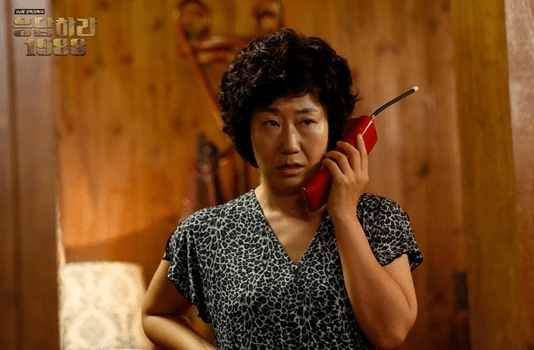
Here is a TV commercial that describes how fast ajummas are. In this TV commercial, they emphasises that their LTE service is faster than ajummas in the subway. This means they’ve provided the fastest LTE service in Korea. In reality, ajummas are faster than Usain Bolt in the subway, for sure.
지금 보여지는 이 광고는 아줌마가 얼마나 빠른지에 대해서 보여주고 있다. 이 광고를 통해, 그들이 제공하는 LTE 서비는 아줌마보다 빠른, 즉 대한민국에서 가장 빠른 LTE서비스를 제공하고 있다는 것을 강조하고 있다. 진짜로 대한민국 아줌마들은 지하철에서만큼은, 우사인 볼트보다 빠르다! 정말로!
한국 여성의 역사는 이 블로그에서 쉽게 얘기할 수 있는 주제는 아니다. 한국의 여성학은 유럽과 같은 서양보다는 늦게 시작되었지만, “한국의 여성학은 서양에서 수입해온 것이 아니라 역사성을 가지고 쌓아올린 매우 주체적 학문” 이다 (장필화 2014). 한국 여성의 역사에 대해서 이 블로그를 통해 다 풀어내지는 못하겠지만 한 가지 말하고 싶은 점은, 한국 여성은 다양하고 복잡한 역사적 사건들과 어려움이 있을때마다 늘 큰 힘이 되어준 한국경제 성장의 주축이라는 것이다. 이러한 점을 염두에 두고 이번 주제를 풀어나갈 것이다. 또한,이 블로그는 논문이 아니기에, 논문에서 다뤘던 내용보다는 좀 더 가벼운 내용에 대해 얘기해 보고자 한다. 한국 여성에 대해서 시간순서대로 나열해 보았고 이번 포스팅에서는 그 첫 번째로 ‘1970년대 (한국전쟁 이후의 여성)’에 대한 내용을 다루고자 한다.
(1)1970년대 (한국전쟁 이후의 여성)
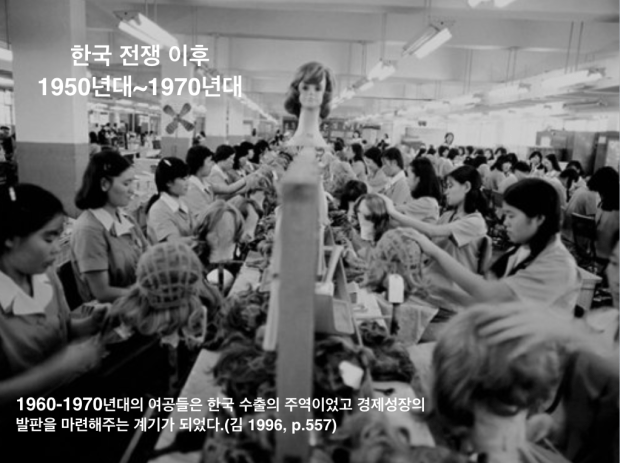
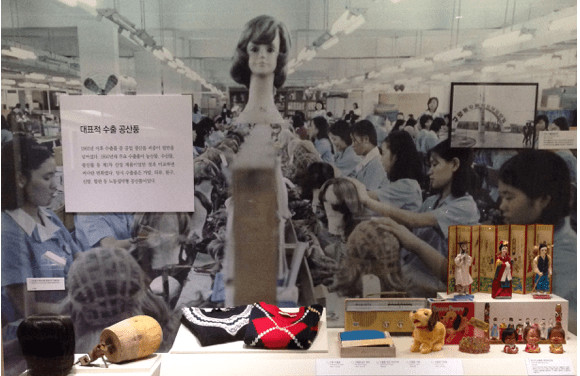
1960-1970년대의 한국 여성들은 나라의 경제성장에 일조를 했다. 한국 전쟁 직후인 1950년대 부터 1970년대 까지 수많은 어린 여학생들은 공장에서 일을 했고, 그 결과 한국은 수출 주도형 성장을 이뤄낼 수 있었다. 오늘날 대부분의 공산품은 (농산물도 예외는 아니지만) made in China이다. 하지만 그 당시에는 대부분의 공산품이 made in Korea이었다고 한다. 예를 들어, 큰 어머니의 가족분들이 미국에 사셨는데 그 때 대부분의 물건들이 made in Korea였다고 지금도 말씀하시곤 한다. 수출을 하던 물품들은 주로 봉제인형, 가발, 양말, 스웨터 등의 물건이었다.
대표적인 수출품 1960년대~1970년대 (서울역사 박물관에서 촬영한 것)
어린 여학생들은 학교에 가서 공부하는 대신 공장에서 하루종일 일했다. 가족들의 생계를 위해 그리고 나라를 위해 여학생들은 공장에서 그렇게 먹고 자며 일을 했다. 이 어렸던 여학생들이 지금은 아줌마가 되어, 우리 엄마의 나이가 되어있는 것이다. 이 분들의 고생 덕분에 우리가 지금 이렇게 잘 지내고 있는것 같아 죄송하고 감사하다.
다음 포스팅에서는 2번째 이야기, IMF (International Monetary Funds) 전의 한국여성에 대해서 이야기할 것이다.





 스마트 아줌마 Smart Ajumma